Nowadays, text messages have been implemented in all languages. French is no exception to the rule, and has its own style playing on the pronunciation of letters and words.
Here you will find some simple to use French text messages that are used for SMS messages and also on the internet.
Since Friday night the political parties, media and opinion polls have been silenced: no one is allowed to comment on the possible outcome.
Today, Sunday, the weather is forecasted to be changeable with rain and showers which is pushing the voters to the voting booths. In the small villages and towns, the votes take place in the town hall, run by the elected council.
Everybody seems to be voting: there is nothing to watch on the TV, no sporting events to attend and the weather is not that pleasant.
Over the years, there are certain French musicians who have marked history. From Classical music to RAP and Rock, there are famous names that you might know, now you can discover much more about music from France
The town of Arles is located between Nimes and Marseille, deep in the Camargue of southern France, with more than 2,500 years of tradition and history much of which is about Bull fighting and horses.
Camargue horsesArles Corrida arenaBull fighting
more
The “priority to the right” rule on the roads of France is complicated and misunderstood by many. In this article, we’ll try and explain some of the principles and “don’t forget” to help you whilst you are driving on the left-hand side of the French roads.
The simplest tip to remember and use is :
When you are driving and unsure, slow down, look to the right and if there is a vehicle coming towards you. GIVE WAY!
Every day in France, there are accidents relating to refusing the priority to the right “refus de priorité”, and in most cases, if you’ve refused the priority, then you’re at fault.
Although I’m not an insurance expert, as far as I know, if you refuse a priority, you’ll be the person held responsible for the accident.
This can also result in a fine of 135 €, a loss of 4 points, and 3 3-year suspension of your licence. Like it or not, the rule does make drivers slow down at any junction.
So let’s have a look at some examples of this very French rule…
Heavy Metal is certainly one of the most popular music in the world, but also one of the least known.
Metal is a genre of music that developed from Rock in the late 1960s and the early 1970s with famous bands such Black Sabbath or Judas Priest and their success also crossed the Channel and the Atlantic. (more…)
The first round of the elections are only a few days away now.
What is happening in France and how do the French voters feel?
The answer to this depends which media / TV / newspaper you read.
They have already taken sides and eliminated all but their two preferred candidate, saying that the final round will be between Sarkozy (Right) and Hollande (Left). (more…)
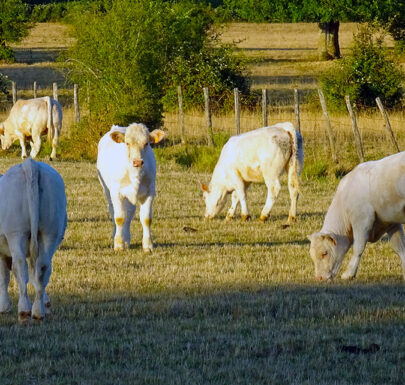
Today is an almost typical working day for Rémi, a French farmer.
Rémi is a 49 year old French farmer, living with his wife and 10 year old son on a typical farm located in central France. He is the son of a farmer and his wife is a farmer’s daughter. They live in a small village in the heart of Burgundy with 120 inhabitants.
Hi, or rather Bonjour. I’ve been living in France for more than 25 years now. Living and working every day with French-speaking people. My sons are both French, the youngest is 14 and the oldest has just turned 18 and is awaiting the results of the famous “Bac” exams.
We live in the countryside, in a small farming village with about 120 inhabitants. A very typical village with mainly old houses and barns, no pavements, no stop signs on the road and the street lights are turned off by the mayor before midnight.
My wonderful friend Ginnie has often talked about her mother’s life in France. Having just returned from a visit there, this is what she had to say:
My mother took early retirement from her teaching career in London, and moved to a beautiful, old farmhouse in South-West France’s Anglars Nozac commune (in the Lot region) about seven years ago. My first thoughts on learning of her intended relocation were:
a) Oh no… one grandparent less to fulfil regular babysitting duties for my then toddler son, Oscar!
b) Fantastic! Oscar and I will benefit from cheap and glorious holidays with a granny/mother who having always been somewhat of a Francophile, would soon be in her element; happy, relaxed, surrounded by gorgeous countryside and enjoying a language and culture she has always loved.
I didn’t mean to go there, it wasn’t my intention at all, and yet what better proof is there of the old adage, “Everything happens for a reason“? Perhaps it was a combination of driving on the right hand side of the road and driving in a right hand drive vehicle. Perhaps it was fate. Whatever the reason, I ended up in the Auvergne, a place I had never heard of before, and I never wanted to leave!
The Auvergne is in the centre of the Massif Central. Of course, being in the middle of France means that it has no coastline. Usually this would be enough to put me off a region but there is enough water in the form of clear blue lakes (lacs), many of which one can swim in, to satisfy my aquatic nature. It is made up of four départements: Puy de Dome, Haute Loire, Cantal and Allier. The capital city of the Auvergne is Clermont Ferrand.
Since first discovering the Auvergne, I have been back many times. Each time I discover something new which delights me as well as rediscovering old favourites. From the volcanic scenery of the Cantal and Puy-de-Dome départements to the plateaux and pine forested landscape of the Livradois-Forez area of the départements of Haute-Loire and Puy-de-Dome, this ever-changing scenery is enough to capture anyone’s heart. One of France’s longest rivers gives its name to the Allier département; its source is in the Lozère and it continues to wind through many places including the Gorges de l’Allier in the Haute Loire before it reaches the Loire. west of Nevers.
The city of Clermont Ferrand, the economic and cultural centre of the Massif Central, is also well worth a visit as it has not only the many shopping, cafés, bars and restaurants which you would expect of any French city but the Auvergne’s capital is also filled with architectural treasures: most notably the gothic style Cathedrale Notre-Dame, which is built out of black lava, and the Basilique Notre Dame du Port, which was built in the 1100s.
Just as one visit could never be enough to see all that the region of the Auvergne has to offer, so one article can never be enough to describe all that there is to discover. For me, the lacs are probably the most appealing feature: most notably Lac Pavin and Le Gour de Tazenat.
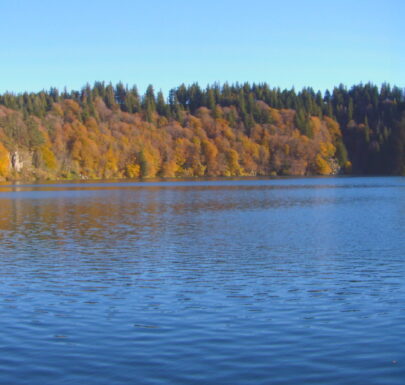
Lac Pavin, which has a wonderful circular walk around its perimeter and water which changes colour as you view it from different perspectives as well as changing with each season, is the deepest lac in the Auvergne and is surrounded by magnificent scenery. This crater lac was formed by a huge volcanic explosion. Visiting Lac Pavin is like stepping into another world as there is often snow on the surrounding Monts d’Auvergne, even when it is warm enough to eat outside in a lower part of the Auvergne. The town of Besse and the ski resort of Super Besse have a distinct Alpine feel.
My other favourite is Le Gour de Tazenat with its forested banks. My children prefer this lake as not only can they swim in it but they can also use their rubber dinghy. Again the surrounding scenery is magnificent.
Apart from water, my other main priorities on holiday are food and drink and the company of friends. As with any French region, there are many specialities. Amongst my lunchtime favourites is a salade Auvergnate comprising a variety of salads, sometimes walnuts, and the melt in your mouth Bleu d’Auvergne cheese or La Fourme d’Ambert which is a milder blue cheese with an almost nutty flavour. Other notable cheeses are St Nectaire (the children’s favourite) and le Cantal. Auvergne wines are little known outside of the region and I hear that no Appellation Contrôlée (AOC) wines are produced there although several VDQS wines (Vin délimité de qualité supérieure) are. Something for us to explore further during our next visit!
No matter what time of year I have visited the Auvergne, there is always something worth visiting. When we last visited during the summer, I thought I already knew what there was on offer but suddenly we stumbled upon a garlic festival in a small town near Clermont Ferrand. We spent a large part of the day browsing the many stalls, not only of garlic but also many other local specialities, and watching the people go by from the terraces of the cafes. I bought a selection of different varieties of garlic and the children, of course, bought beach towels which could have come from any market in any country in the world!
My overriding recollection of the Auvergne, and what takes me back time after time, is that of fresh, clean air; cool, clear waters; the most amazingly friendly and hospitable people and an overwhelming sensation of peace.
At this time of the year many French students are awaiting or have resceived the results for their Baccalauréat, the end of school exam. Obtaining a result is cruicial to continue an educational path, as a good result will provide university entrance, whilst a failure means the doors will close and the student will either redo a complete school year or simple give up and try something else. (more…)
Well in France, most people are remaining calm about what certain people call a national disaster.
We thought it would be fun to share some of the jokes which you which are flying around. The jokes are in French with an English translation and some explanations about the play on words.
Joke 1 :
Deux africains arrivent et disent à l’équipe de France ” Et bien, vous vous en allez déjà ? ”
Translation
Two Africans arrive and say to the French team “Oh well, are you already leaving ?”
( vous vous en allez : vuvuzela )
Joke 2 :
En 2006, l’équipe d’Italie et l’équipe de France ce sont rencontrées en finale, cette année c’est à l’aéroport.
Translation
In 2006, the Italy team and the French team meet in the final, this year they meet in the airport.
Joke 3 :
Ils sont venus, ils ont vu et l’on eu dans le cul. Si vous voulez voir des Bleus gagner, regardez Avatar.
Translation
They came, they saw and they go it in the ‘backside’. If you want to see the Blues win, watch Avatar.
You have a play on the latin “Veni, vidi, vici”. The nickname for the French team is the “Blues”
Joke 4 :
Zidane la tête, Henry la main, Ribéry le sexe, à quand le jeu au pied ?
Translation
Zidane with the head, Henry with the Hand, Ribéry with his ****, when will the game be played with feet.
Well yes, sometimes for good reasons, sometimes for no reason at all.
In French strike is “GRÈVE”.
The French do have a bad reputation for striking and at lightning speed. The Métro in Paris and the SNCF (the trains) are good examples. A strike may be launched for next to no reason and the whole country comes to a total stand-still.
Workers unions retain a strong position of power, not only in the civil service but also the private sectors such as the farmers and truck drivers. Roads can be blocked, tonnes of grapes can be dumped on the road and Mayors can be walled into the town hall from the outside.
I’ve seen people having to leave home at 4 am to get to work at 9am because there are no trains, buses or taxi’s, with freezing temperatures.
I’ve seen workers ready to blow blow-up factories trying to save their jobs as the investors run off with government grants (tax money ).
I’ve seen nurses receiving no salary as they fight for hospital beds to heal the sick.
I’ve seen fishermen blocking harbors because they can no longer earn a living because of a decision by person in the EEC who has never been to the seaside.
I’ve seen the Police and Firemen hitting other Policemen as they fight for better conditions.
I’ve seen university students, school students and teachers pleading for more classrooms.
I’ve seen manifestations of retired people who can no longer pay heating bills.
Have you every seen homeless people asking for a bit of food, and shelter ? Who live in a tent to stop the rain, as they camp along the banks of the river Seine.
There are also other ways to strike, some strike for gold in the Olympics, many of these people are own know to us all and practice a sport only pleasure (and of course ambition) with very little financial benefit.
In football there are two methods in striking, we all know about striking as in shooting, striking for goal. This week we have learned about another method.
Strike and not play but get payed.
These are difficult times for many people throughout the world. The least we can expect from the French football team is to “STRIKE HOME”, and with the money most of these top players earn, pay back some of those who are in need and stricken out by our modern way of life.
Let’s hope for a different way of thinking in 2014.
But how do you say : Lose, disaster, useless, sack the boss, losers, goalless.
Or
How do you say : Win, no luck, bad draw, that’s life, goal, attack, score.
I’m actually writing this article a few minutes before the match between Mexico and France. I have a bet with a friend that Mexico will win 2-1. With nearly 2 hours to go, we’ll see who wins and perhaps I owe a bottle of wine ! Even if I do lose the bet, my friend will share the bottle of wine.
Anyhow, this is a good time to learn some French vocabulary about winning and losing.
A big discussion in France is about yesterday’s “Bac de Philosophie”, which is the Philosophy Baccalaureate exam. The subject is one of the most complicated and stressful for students, and quite a few people will fail in this exam.
Perhaps the theme could have been “Will you have a winning team, when you have the best players ?”.
Let’s have a quick look at three French words, with different spelling and different meanings, but to the unaccustomed ear, they sound very similar and can lead to confusion.
Toi, trois & toit
Toi which means “you” or “yourself”
Trois which is the number “three”
Toit which means “roof”
The best way to avoid confusion is to understand the context of the phrase where these words are being used. If you practice and listen to the French language, you will eventually be able to notice the difference in the pronunciation of these words.
Here are some other examples where words have the same sound but different spelling:
Moi and mois, which mean me and month
Soi and soie, self and silk
Pois and poids which gives peas and weight
Another example where French comprehension can but difficult is with the words Dessus and Dessous. Dessus means on or on top of whilst the opposite is Dessous means under, beneath, or below
There is also very little difference in the pronunciation of both of these words; so you must really lend an ear and listen.
An excellent method in practicing your French and overcoming the problem of comprehension and vocabulary is to use “Audio-comparative” exercises. I strongly recommend using the French 4U language course, which is available on the Internet and offer such exercises as part of the language program. You can test the demo course now and learn French.
The wines of Burgundy are very well known and appreciated throughout the world.
The next time you are in the Beaune, Nuits Saint Georges or Dijon, take the opportunity to discover all secrets which are in a real bottle of wine.
I would recommend the talent and enthusiasm of Mr Max Renau. He offers a unique insight and voyage through the Côte d’Or vineyards, sharing everything he knows with you.
Max took us on a tour at the beginning of June this year. Meeting us at our hotel in Dijon, with a warm greeting we climbed aboard the mini-bus and Max took us on an incredible voyage in to the heart of the Burgundian wine culture.
With a charming French accent, we were guided out of Dijon to encounter the first vineyards at Marsannay and soon arrived at the impressive Clos de Vougeot, home to La Confrérie des Chevaliers du Tastevin. As Max explained the dates and story of the Abbey we began to understand the historical importance of the magnificent construction.
Max then guided us to the frontier between the Côte de Nuits and Côte de Beaune in the domain of Clos des Langres. A mansion house built in the middle of a walled vineyard.
We drove through the charming village of Aloxe Corton and up to the famous Corton-Charlemagne Grand Cru and then down to the red Pinot Noir Pernand Vergelesses. In the middle of the fields, Max explained the finest details about growing grapes and all the different stages throughout the year which are necessary to produce a wine harvest.
Our guide and now friend then drives us a few miles south of Beaune, through Pommard to the quiet village of Volany. He had promised us the most delicious Coq-au-vin (Chicken in red wine sauce). After the glasses of wine we had already tasted, stomachs were ready to savor some traditional French cuisine.
Cellier Volnaysien restaurant
We entered the “Cellier Volnaysien”, which is a vaulted stone walled wine cellar that has been converted in to a restaurant. Max introduced us to the lady of the house Nathalie Pont, a tall and elegant French lady. We didn’t even have to use the menus as Max’s mouth watering description of the dishes left us no choice but to follow his suggestions. What a Meal !
During the meal we were able to pry into Max’s knowledge and asked many questions, the answers were always there and with some surprises, he was always ready to remove or change our prejudgments.
With our full and calm stomachs we continued to Mersault and then Chassagne Montrachet. This was to be the highlight of the tour. We were taken into a private house and a huge cellar to be introduced to Laurent. Here we tasted the finest white Chardonnay wines I have had the chance to drink.
I will not give you any more information about wine grower in Chassagne Montrachet, as I want this secret to remain so and be sure that some wine remains the next time we visit.
The clock told us that it was time to leave Max, but the hours had flown by to quickly, we still wanted more from him.
Today the weather is good, sunshine and the village cafe is open, with tables and chairs on the terrace.
It’s 18.00hrs and Pierre has just finished work. He decides to have some time off with a drink in the café.
As he takes a chair at an empty table, he greets the other people he knows with a handshake, with a soft voice he asks the barman for a “demi”, a 1/2 pint glass of beer.
The waiter serves the beer to Gilbert, who lays back in the chair and sips his drink, watching the cars and people walk by. A few metres away he notices an old friend heading towards him and shouts out “Salut Pierre, tu prendre un verre avec moi” (Hi Pierre, have a glass with me).
Pierre replies “Bonjour Gilbert, comment va tu ?” (Good-day Gilbert, how are you ?)
“Ca va merci. Qu’est que tu veut boire ?” (Fine thanks. What would you like to drink ?)
“Un Pastis s’il te plait” (A Pastis please [Aniseed aperitif])
The waiter serves the drink and the two men talk about day to day life.
“La famille va bien ?” (Is the family ok ?)
Pierre explains that his eldest son will soon be taking his Baccalaureate exams, but doesn’t seem to be revising enough. His wife has finally found a part-time job in a nearby supermarket. She will be working 20 hours a week with the SMIC (minimum legal salary ) of 9Euros per hour.
Gilbert begins to moan about the current high price of petrol, now at 1.32Euro, when it was only at 1.14 in January. He is worried because at the end of every month he is obliged to take money from his “Livret A” (Savings account) to pay all the bills.
Gilbert earns 2000Euro per month plus commissions on sales, but the current economy has reduced the spending of his clients so his salary is much less than 2 years ago. “Travailler plus pour gagner plus” (work more and earn more), he shouts aloud. “That’s what the president promised us, but I’m working much more and earning a lot less !”
Pierre says “Et oui, les temps sont durs” (Ah yes, times are hard).
Pierre tries to change the subject and ask “Tu a des projets pour les vacances d’été ?” (Do you have projects for the summer holidays ?)
“Oui, la Vendée, chez mes amis”, (Yes, the Vendee, by my friends).
“j’aime beaucoup la région, le soleil, la mer et les gens sont sympas”. (I love the region, the sun, the sea and the people are friendly).
Gilbert ask if Pierre will watch the “La Coupe du Monde” ( the world cup).
“Oui un peut, mais on a aucune chance”. (Yes a bit, but we have no chance).
This is typical French pessimism. Et c’est comme ça ici
France is a very strange country… the French are a real mixture of cultures who have been coming and going throughout the centuries.
Full of cliches. In the north it rains, in the south it is hot. In the west they drink, in the east they are unfriendly.
And each region and department of France is very different. Parisians are not like Burundians who are not like Alsaciens.The mentality, dress and cuisine are not of the same flavour.
Even more, neighboring towns and villages are different. In the countryside a village will still retain a dialect/slang “patois” which is meaningless a few miles away. A street will be named after a heroic person, artist or writer. The yearly village festival are is always better than down the road.
There is even proof that the famous Pizza is now of French origin (now offense to Italians). The French love French cars such as Renault and Citröen. They have the best football team except when they lose. No other wine is worth drinking and the English can’t cook.
But I think you will find the same attitude in every country.
So why is France a strange country ?
The average French person has a job and goes to work. At the end of the month they are given a salary. Every so often he will take a holiday… AH THAT’S THE DIFFERENCE.
The French have more holidays than elsewhere in the world.
That is what makes France a strange place… they have so much time for holidays.
But don’t be misguided, the average French person has to work and pay some of the highest taxes in Europe.
So is it bad to want to have fun ? Time to relax. Precious moments with family and friends. Enjoying life. Perhaps it’s a question of priorities and your average Monsieur Dupont knows that it is not just money which brings happiness.
I say : “Long live Mr Dupont ! Let’s have a glass of wine together. I’m sure we have something in common”